Choosing a commercial dishwasher is not simply a matter of buying the machine with the highest output. The right choice depends on how many items arrive at the wash area during your busiest period, how staff move through the space, what types of ware you wash, and which utilities are available on site.
For many restaurants, cafés, bars, hotels, and catering facilities, the decision comes down to two popular formats: an undercounter dishwasher and a hood-type dishwasher, also known as a pass-through or door-type dishwasher.
Both can deliver reliable commercial cleaning and sanitizing. However, they are designed for different workloads and workflows. This guide explains the key differences and helps you choose the better fit for your operation.
The Short Answer
Choose an undercounter dishwasher when space is limited, wash volume is light to moderate, and you want the machine close to the point of use.
Choose a hood-type dishwasher when you need faster rack handling, greater peak-hour capacity, and a more efficient dirty-to-clean workflow.
If your operation produces a continuous, very high volume of ware throughout the day, you may need to consider a conveyor dishwasher instead.
What Is an Undercounter Dishwasher?
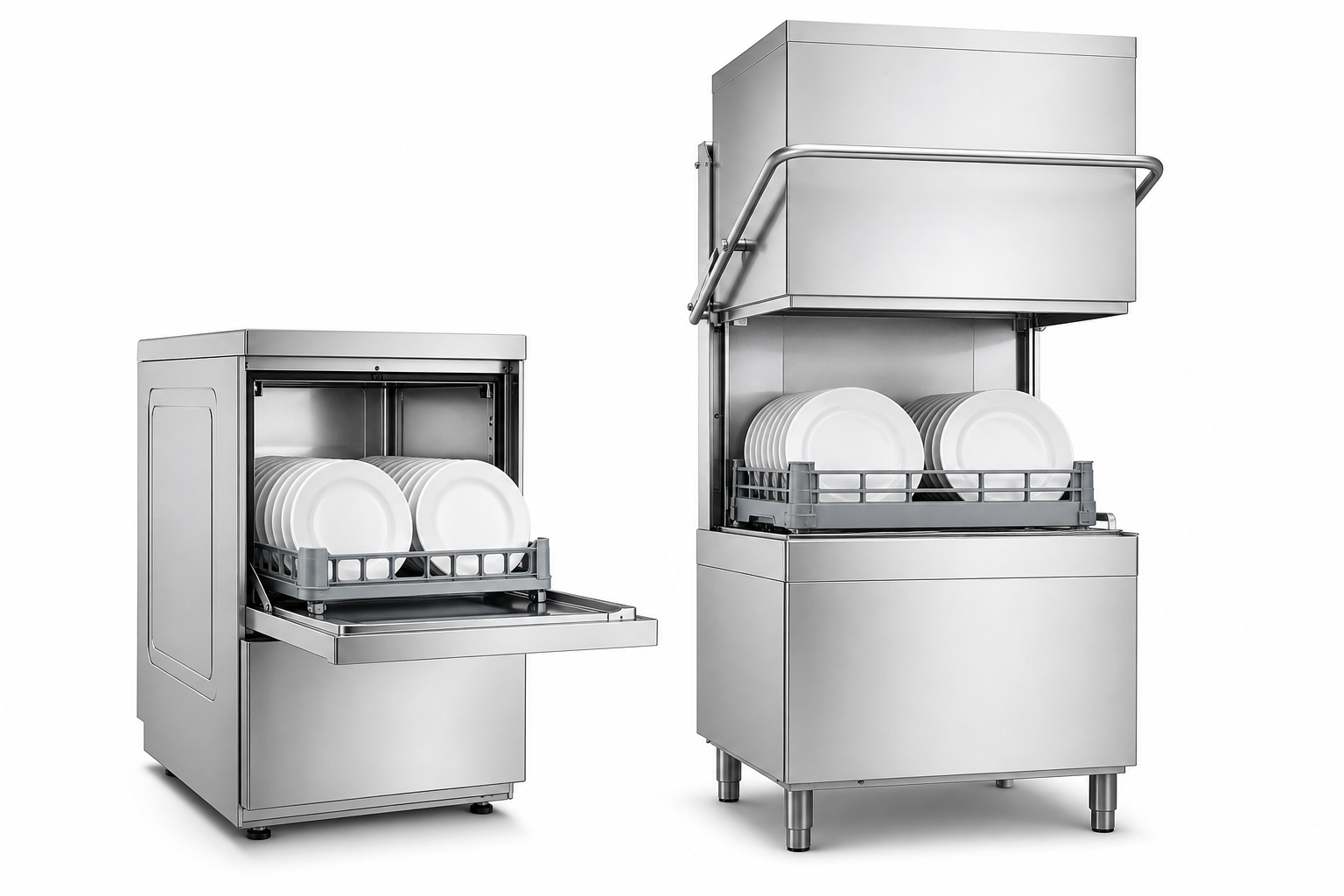
An undercounter commercial dishwasher is a front-loading machine designed to fit beneath a standard work surface. It has a compact footprint and can often be installed near a bar, coffee station, preparation area, or small kitchen wash zone.
The operator opens the front door, slides in a loaded rack, closes the door, and starts the cycle. Because loading and unloading happen from the same side, the machine requires little surrounding space. However, staff usually need to bend repeatedly during busy periods.
Undercounter models are commonly used in:
• Cafés and coffee shops
• Bars and pubs
• Small restaurants
• Bakeries
• Care facilities and office pantries
• Satellite kitchens
• Front-of-house glasswashing stations
What Is a Hood-Type Dishwasher?
A hood-type dishwasher is a larger, floor-standing machine positioned between an inlet table and an outlet table. The operator slides a loaded rack into the wash chamber, lowers the hood, runs the cycle, and then moves the clean rack to the other side.
This pass-through arrangement creates a natural flow from scraping and pre-rinsing to washing, drying, and storage. Racks stay near working height, which can reduce bending and make repeated loading easier during a busy service.
Hood-type models are commonly used in:
• Full-service restaurants
• Hotels and resorts
• School and workplace kitchens
• Catering operations
• Supermarkets and food-production areas
• Medium- to high-volume institutional kitchens
Undercounter vs Hood-Type Dishwasher: Key Differences
Factor | Undercounter Dishwasher | Hood-Type Dishwasher |
Best suited to | Light to moderate demand | Moderate to high demand |
Installation footprint | Compact; fits below a counter | Requires floor space plus tabling |
Rack movement | Load and unload from the front | Pass-through movement from dirty to clean side |
Peak-period performance | Better for smaller or intermittent batches | Better for repeated rack processing |
Operator movement | More bending and front access | Working-height rack handling |
Typical location | Bar, café, small kitchen, satellite station | Dedicated dishroom or main kitchen |
Initial investment | Usually lower | Usually higher, especially with tabling and ventilation |
Growth capacity | Limited | Better suited to increasing volume |
Actual cycle time, rack capacity, water use, and utility requirements vary by model. Always compare manufacturer data for the exact machines on your shortlist.
1. Measure Peak Demand, Not Just Daily Volume
Daily cover count is useful, but it does not show how hard the dishwasher must work at the busiest moment. A restaurant serving 200 guests gradually may have different needs from a banquet venue that clears 200 place settings within 20 minutes.
Estimate how many racks you need to process during your busiest 15- or 30-minute period. Include plates, bowls, cups, glasses, cutlery, trays, and preparation utensils. Then allow time for scraping, sorting, rack loading, washing, unloading, and air drying.
An undercounter machine can be effective when loads arrive in smaller batches. A hood-type machine is generally the stronger choice when racks build up quickly and must move continuously through the wash area.
Do not size the machine according to its theoretical maximum alone. Real-world output is affected by staff speed, ware sorting, heavily soiled items, cycle selection, incoming water conditions, and available drying space.
2. Look at the Entire Wash Area
An undercounter unit saves floor space, but the machine itself is only part of the layout. You still need room for dirty ware, pre-rinsing, detergent storage, clean ware, and safe air drying.
A hood-type dishwasher occupies more space and normally needs inlet and outlet tables. In return, it can support a clearer one-way process:
Dirty drop-off -> Scrape and pre-rinse -> Load rack -> Wash -> Air dry -> Store
This separation helps reduce unnecessary handling and lowers the risk of clean items returning to the dirty side. Before choosing a machine, map the movement of both staff and ware through the area-not just the equipment dimensions.
3. Consider What You Wash
Different types of ware place different demands on a dishwasher.
• Glasses: Look for appropriate racks, gentle cycles, effective rinse performance, and water treatment where mineral deposits are a concern.
• Plates and bowls: Make sure standard racks fit your menu’s shapes and sizes efficiently.
• Pots, pans, and utensils: Check the usable chamber opening, clearance height, wash pressure, and availability of dedicated utensil cycles.
• Trays and larger items: Confirm that the machine can physically accept them without awkward loading.
An undercounter model may be ideal for glassware or standard place settings but too restrictive for bulky kitchen items. A hood-type machine usually offers easier access and greater loading flexibility, although it should not automatically be treated as a replacement for a dedicated pot washer.
4. Account for Labor and Ergonomics
Dishwashing is repetitive, physical work. Small workflow differences become significant over hundreds of cycles.
With an undercounter machine, the operator bends to load and unload every rack. This may be perfectly manageable in a lower-volume operation. During a long, high-volume shift, however, it can slow the process and increase physical strain.
A hood-type machine keeps racks at working height and lets staff slide them between tables and the wash chamber. It can support a smoother rhythm and reduce lifting. For operations where labor availability and employee retention are ongoing concerns, workflow and ergonomics deserve as much attention as the machine’s rated output.
5. Check Utilities and Installation Requirements
Before ordering either type, confirm the site conditions with the equipment supplier and qualified local contractors. Review:
• Electrical supply, voltage, phase, and breaker capacity
• Incoming water temperature and pressure
• Hot-water recovery capacity
• Drain position and drainage requirements
• Water hardness and treatment needs
• Detergent and rinse-aid connections
• Ventilation, steam, and heat-management requirements
• Local hygiene, plumbing, electrical, and building codes
Some high-temperature machines use a booster heater to reach the required sanitizing rinse temperature. Low-temperature machines use an approved chemical sanitizer instead. Each approach affects utility demand, chemical use, ventilation, operating cost, and local compliance.
Do not assume that a compact undercounter machine will be a simple plug-in replacement or that every hood-type machine needs the same ventilation arrangement. Requirements differ by model and jurisdiction.
6. Compare Total Cost of Ownership
Purchase price is only the beginning. A useful comparison should include:
• Installation and any electrical or plumbing upgrades
• Inlet and outlet tables
• Water and energy consumption per rack
• Detergent, rinse aid, and sanitizer use
• Water filtration or softening
• Routine cleaning and preventive maintenance
• Service access and spare-parts availability
• Labor required per rack
• Expected usable life and future capacity
An undercounter dishwasher often has the lower initial cost. But if staff must run it continuously, wait for clean ware, or wash overflow by hand, the apparent saving can disappear.
A hood-type dishwasher usually requires a larger initial investment, yet its workflow and higher practical throughput may reduce labor pressure and provide room for growth. The better value is the machine that meets demand reliably at the lowest cost per clean rack over its working life.
When comparing efficiency, use independently verified product data where available. For example, ENERGY STAR evaluates eligible commercial dishwashers using machine-specific limits for idle energy and water consumption rather than treating all dishwasher types as identical.
7. Plan for Your Next Busy Season
Buying only for today’s average demand can lead to an early replacement. Consider whether the business may add seats, extend opening hours, expand the menu, increase takeaway production, host events, or centralize washing from another service area.
An undercounter unit is a sensible, efficient choice when its compact format genuinely matches the operation. It can also work well as a second machine dedicated to glasses or as support for a remote service point.
If you are already close to the limit of an undercounter machine during peak periods, moving to a hood-type system may be more economical than adding labor or coping with recurring bottlenecks.
Which Dishwasher Is Right for You?
Choose an Undercounter Dishwasher If:
• Your wash volume is light to moderate
• Space is extremely limited
• Loads arrive intermittently rather than in large waves
• The machine will sit near a bar, coffee station, or service point
• You mainly wash glasses, cups, cutlery, or standard place settings
• A lower initial investment is important
• Staff can load and unload from the same side without disrupting the workflow
Choose a Hood-Type Dishwasher If:
• You operate a busy restaurant, hotel, canteen, or catering kitchen
• Racks accumulate quickly during peak service
• You have space for a dedicated dirty-to-clean wash line
• Reducing bending and manual handling is a priority
• You wash a wider mix of plates, trays, and kitchen utensils
• You expect the business or wash volume to grow
• Fast, repeatable rack movement is more important than minimum footprint
Questions to Ask Before You Buy
Use this checklist when comparing specific models:
1. How many racks must we wash during our busiest 30 minutes?
2. What is the machine’s practical output using our normal cycle?
3. Will our largest plates, trays, and utensils fit comfortably?
4. How much space is required for loading, unloading, and air drying?
5. What electrical, water, drainage, and ventilation work is needed?
6. Is water treatment recommended for our location?
7. How much water, energy, and chemical does the machine use per rack?
8. How easy is daily cleaning and routine maintenance?
9. Are trained service technicians and spare parts available locally?
10. Will the machine still meet demand if the business grows?
Final Recommendation
The choice between an undercounter and hood-type dishwasher comes down to four things: peak demand, available space, workflow, and total operating cost.
For a compact venue with manageable batches, an undercounter dishwasher can provide excellent performance without taking over the kitchen. For a busier operation that needs racks to move quickly and consistently, a hood-type dishwasher is usually the more productive long-term choice.
Still unsure which format fits your kitchen? Talk to our commercial dishwashing team. We can review your menu, peak volume, available space, utilities, and workflow to help you select a solution that performs reliably from the first service to the last.
undercounter vs hood-type dishwasher